LLM powered data structures: A concurrent, lock-free binary search tree
In a previous post I introduced parallel primitives for LLM workflows, and in a follow-up applied them to search and rank 2.4 million arXiv papers. The ranking step used quicksort with an LLM comparator: To sort a list of items, we partition them around a pivot, then recurse on the partitioned halves, and let the parallelism emerge from the recursion structure.
I want to introduce a neat alternative that comes from thinking about data structures rather than algorithms. Instead of designing a computation that transforms an unsorted list into a sorted one, you can ask: what data structure would make sorted order easy to maintain? One really nice answer is a binary search tree. Insert items, and sorted order falls out as a side effect of the invariants of the BST structure.
The parallelism story is different from quicksort. In quicksort, you get parallelism at each level of recursion: all comparisons against the pivot happen at once, then the two partitions sort in parallel. In a BST (as we’ll see), you get parallelism across insertions: multiple items traverse the tree simultaneously, each racing down toward its insertion point. The total comparison count is the same, , but the shape of the parallelism is different. The result is a kind of LLM powered index for your data1.
Let’s walk through how to build one that works well when comparisons are expensive and async.
BST insertion
A binary search tree maintains a simple invariant: for every node, everything in
its left subtree is smaller, and everything in its right subtree is larger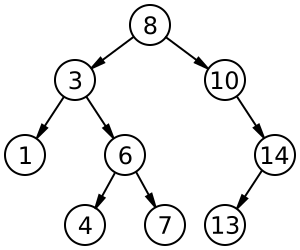 A BST. Everything left of 8 is smaller; everything right is larger. The property holds recursively at every node..
To insert a new item, you compare it against the root; if it’s smaller, you
recurse into the left subtree, otherwise the right. When you hit an empty spot,
you’ve found your insertion point.
A BST. Everything left of 8 is smaller; everything right is larger. The property holds recursively at every node..
To insert a new item, you compare it against the root; if it’s smaller, you
recurse into the left subtree, otherwise the right. When you hit an empty spot,
you’ve found your insertion point.
async def insert(self, value: T) -> None:
    node = self._root
    while node is not None:
        cmp = await self._compare(value, node.value)
        if cmp < 0:
            if node.left is None:
                node.left = Node(value)
                return
            node = node.left
        else:
            if node.right is None:
                node.right = Node(value)
                return
            node = node.right
The comparison function is async because, in our case, it might be an LLM call.
For a tree of depth , insertion requires comparisons, one at each level
as you descend. A balanced tree has depth n being the total number of elements in the tree., so insertion is
comparisons.
Parallel insertion
If each comparison is an LLM call, it might take 500ms. To insert items into a tree of depth , you need comparisons. Do them sequentially and you’re waiting a long time. For 1000 items in a balanced tree, that’s roughly 10,000 comparisons, or about 80 minutes of wall-clock time spent waiting for LLM responses.
But most of those comparisons don’t depend on each other. When item A is comparing against the root, item B could be comparing against a node in the left subtree, and item C somewhere in the right subtree. They’re touching different nodes, so there’s no reason they can’t proceed in parallel:
                      ┌───┐
                      │ 5 │ ← A comparing here
                      └───┘
                     ╱     ╲
                    ╱       ╲
                ┌───┐       ┌───┐
    B here →    │ 2 │       │ 8 │    ← C comparing here
                └───┘       └───┘
               ╱     ╲           ╲
              ╱       ╲           ╲
          ┌───┐     ┌───┐       ┌───┐
          │ 1 │     │ 3 │       │ 9 │
          └───┘     └───┘       └───┘
The interface is just asyncio.gather over the insertions:
tree = BST(llm_compare)
await asyncio.gather(*[tree.insert(item) for item in items])
When you fire off all the insertions at once, each item starts traversing the tree independently, racing down toward its insertion point.
Each insertion does comparisons as it descends, and there are insertions, so we’re still doing comparisons total. But the shape of the parallelism is different from quicksort. In quicksort, you get parallelism within each partition: all elements compare against the pivot simultaneously, then you recurse. In the BST, you get parallelism across insertions: all items are traversing the tree at once, but each one is doing its own sequential chain of comparisons down from root to leaf.
There’s a problem lurking here, though. What happens when two items race down the same path and both try to insert at the same spot? If A and B both decide they belong as the left child of some node, one of them is going to have a bad time. We need some kind of concurrency control.
Two-phase insertion with optimistic concurrency
The naive fix is a global lock: acquire it before traversing, release it after inserting. But that serializes everything. We’d be back to doing one comparison at a time, waiting for each LLM call to complete before starting the next.
The insight is that comparisons don’t modify the tree. They just read a node’s value and decide left or right. The only mutation happens at the end, when we link the new node as someone’s child. So we can split insertion into two phases: a lock-free traversal where we do all the expensive comparisons, and a brief locked phase where we do the pointer write.
async def insert(self, value: T) -> None:
    while retries < max_retries:
        # Phase 1: Traverse to find insertion point (no lock)
        node = self._root
        parent = None
        go_left = False

        while node is not None:
            saved_version = node.version
            cmp = await self._compare(value, node.value)  # expensive!

            if node.version != saved_version:
                break  # tree changed, restart

            parent = node
            go_left = cmp < 0
            node = node.left if go_left else node.right
        else:
            # Phase 2: Link new node (with lock)
            async with self._link_lock:
                if go_left and parent.left is None:
                    parent.left = Node(value)
                    return
                elif not go_left and parent.right is None:
                    parent.right = Node(value)
                    return
            # slot was taken, retry
        retries += 1
The node.version field is the key. Each node has a version counter that gets
bumped whenever its children change. After doing an expensive comparison, we
check if the version changed while we were waiting. If it did, the tree
structure might have shifted under us: maybe a new child appeared exactly where
we were about to insert. Rather than try to recover, we restart from the root.
This is optimistic concurrency control. We assume conflicts are rare, proceed without locking, and pay a retry cost when we’re wrong. There’s a tension here: optimistic locking is usually attractive when retries are cheap, but retrying here means throwing away LLM calls and starting over. The saving grace is that conflicts require two items to reach the same insertion point at nearly the same instant. With comparisons taking hundreds of milliseconds, that window is tiny, and items on different paths don’t conflict at all. In practice, with hundreds of concurrent insertions, retries are rare. And if you do retry, you can cache the comparison results from your first attempt - the retry just replays the cached answers until it reaches the point where the tree changed.
The lock itself is minimal: just the pointer assignment to link the new node. Everything expensive happens outside the lock.
Threaded linked list for free iteration
Once you’ve built the tree, you’ll want to access the sorted results. With a
plain BST, finding the minimum means walking down the left spineThis is O(log n) cheap pointer hops, not O(log n) expensive comparisons.
The threading is a nice-to-have since we’re already doing pointer updates
during insertion.. Threading
a linked list through the nodes makes min O(1), and iteration becomes simple
pointer chasing instead of tree traversal. Each node gets
prev and next pointers to its in-order predecessor and successor:
@dataclass
class Node(Generic[T]):
    value: T
    left: Node[T] | None = None
    right: Node[T] | None = None
    prev: Node[T] | None = None   # in-order predecessor
    next: Node[T] | None = None   # in-order successor
The tree also keeps _head and _tail pointers to the smallest and largest
nodes. When we insert a new node, we thread it into the list as part of the
linking phase:
if go_left:
    parent.left = new_node
    # new_node comes just before parent in sorted order
    new_node.next = parent
    new_node.prev = parent.prev
    if parent.prev:
        parent.prev.next = new_node
    else:
        self._head = new_node
    parent.prev = new_node
The key insight is that in a BST, a node’s in-order predecessor is always the parent you most recently went left from. When you insert as a left child, you slot in just before your parent. When you insert as a right child, you slot in just after. So we can maintain the threading during insertion with just a few pointer updates, all inside the lock we already hold.
Now iteration is just pointer chasing:
def __iter__(self) -> Iterator[T]:
    node = self._head
    while node is not None:
        yield node.value
        node = node.next
And min/max are :
@property
def min(self) -> T | None:
    return self._head.value if self._head else None
Prefix caching and argument order
Most LLM providers offer prefix caching: prompts sharing a common prefix reuse cached computation. For comparison prompts, this creates a tradeoff in how you order the arguments, especially when comparing large items.
Item-first ordering: When inserting item X, the comparisons are (X, root), (X, child), (X, grandchild), and so on. These all share X’s description as a prefix. As X descends the tree, each comparison benefits from having X already cached. You get good temporal locality within a single insertion.
Node-first ordering: The comparisons become (root, X), (root, Y), (root, Z) for different insertions. All comparisons against the same node share that node’s description as a prefix, and you get good sharing across concurrent insertions hitting popular nodes.
The performance difference comes down to cache size. Node-first wins if the cache is large enough to hold the whole tree: every node’s prefix stays warm, and comparisons against it keep hitting. Item-first wins if the cache churns: an item’s own comparisons happen in quick succession as it descends, so its prefix stays warm even if older nodes have been evicted.
Limitations
Tree balance. If you insert items in already-sorted order, the tree degenerates into a linked list with depth . Every insertion traverses the whole spine, and you lose all parallelism. The fix is either to randomize insertion order or use a self-balancing tree. The implementation here doesn’t self-balance, so shuffle your inputs.
Comparison transitivity. BSTs assume transitive comparisons: if A < B and B < C, then A < C. LLM comparisons don’t always satisfy this - they can be inconsistent, especially for items that are close in rank. The tree will still produce some ordering, but it might not match what you’d get from a different insertion order. If you need robust rankings despite inconsistent comparisons, consider voting across multiple comparisons or using a different ranking algorithm.
No deletion. We didn’t cover deletion, and some design choices (like full restart on version conflict) are conservative in ways that would matter more if we did.
Conclusion
We built a BST optimized for expensive async comparisons: parallel insertion with optimistic concurrency control, and a threaded linked list for access to sorted results. The implementation lives in parfold2.
The result is less a sorting algorithm than an index. During construction, you’re asking the LLM “is A better than B?” for hundreds of pairs, and the tree structure encodes all those answers into something you can query later without making further calls. The BST becomes a materialized view of the LLM’s judgment - you pay for the comparisons once, and then you can access min, max, or the full sorted order as many times as you like, for free.
Footnotes
-
This resembles embedding-powered vector indexes: both front-load work to make later queries cheap. The difference is in the metric. With embeddings, comparisons are always cosine distance to fixed vectors, even while your prompt shapes the query vector. Generative models are more steerable - they read the full documents and can follow whatever comparison criteria you specify. The tradeoff is cost. ↩
-
It’s in python! Because we’re calling LLMs for each comparison, we don’t care about cache locality or the number of instructions we’re using or threading, &c., so python + async/await works fine. ↩
Last modified: 17 Feb 2026